Navigation Systems
 Fleet Manager
 TOOLS & EXTENSIONS
.png?width=1200&height=675&name=BB%20Support%20(1).png)
.png) ENGINEERING
ENGINEERING
.png)
.png) COMPANY
COMPANY
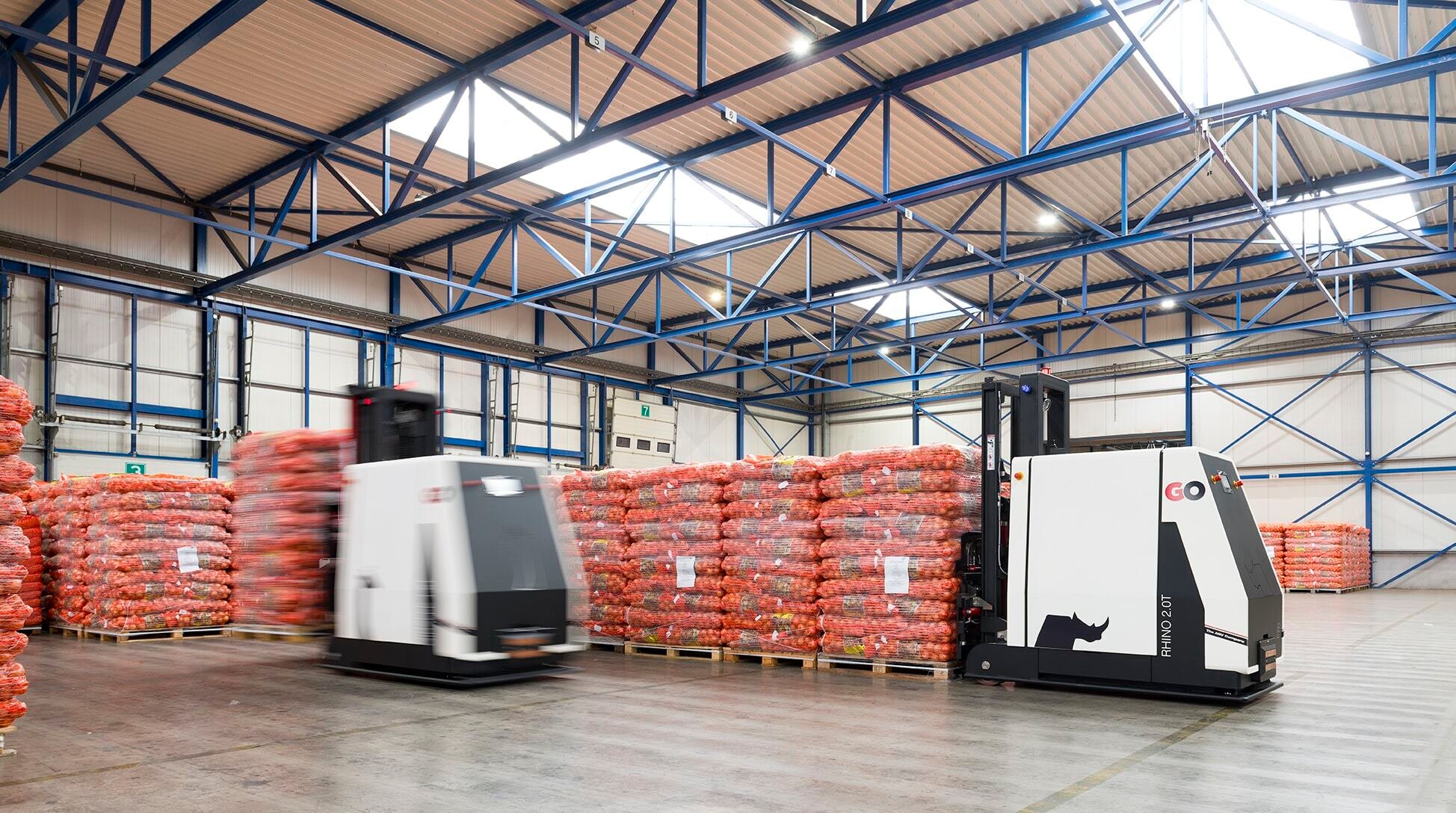

A crucial step when comparing AGV/AMR navigation systems is to see these technologies in action. So if you are not ready to visit navigation providers, trade show demonstrations can be the next best thing.
However, not all trade show demos are created equal.
Some AGV demos are more ‘real’ than others. What should you be looking for? How can you tell when a technology is running on its core functionality versus having been carefully programmed just for a specific event? Since the decisions you make when choosing an automation partner could influence your company’s commercial success (and your reputation) for years to come, you don’t want to risk being misled.
Here are our seven tips to help you best assess autonomous navigation systems at trade shows:
1. Look down to identify which navigation system is being used
Many companies will stock their booths with AGVs (automated guided vehicles) and AMRs (autonomous mobile robots). It’s impressive to see a demo of these vehicles, but the really important technology is “under the hood.” To figure out what sort of navigation system is being used to drive these vehicles – look down.
- Are there markings on the floor? Tape, painted lines, wires or RF/QR tags is a giveaway that the vehicle is using line or tag following technology.
- Is there carpet on the floor? This may mean the marketing team had a little extra budget for the show… or occasionally, it might mean that the company is hiding magnets, inductive wires or RF tags beneath the carpet.
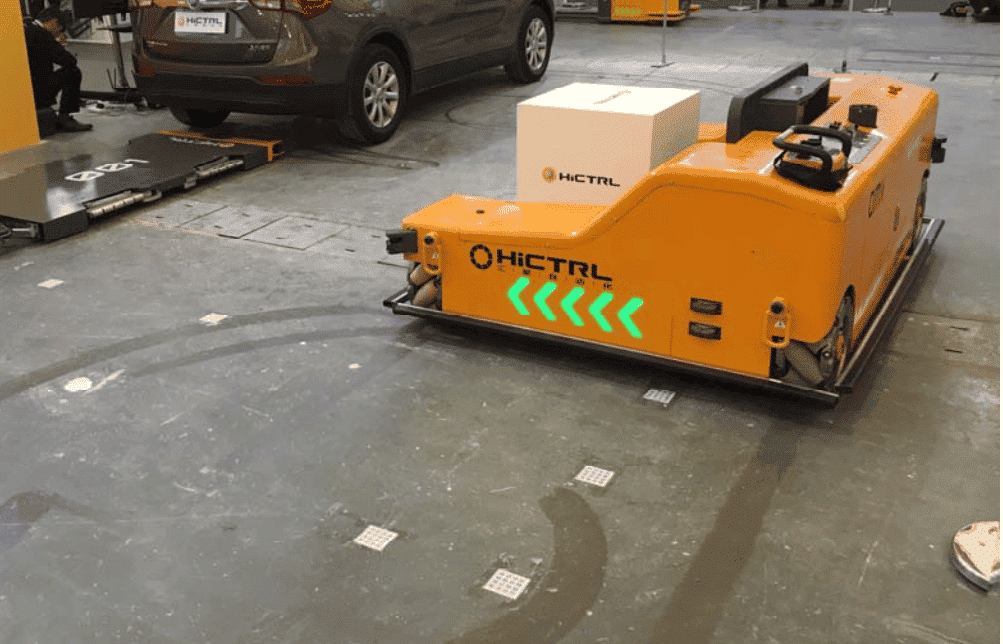
Markings on the floor can indicate the vehicle is using line or tag following technology. QR tags are commonly used in ecommerce and fulfillment centers, but are found less often in warehouses and on factory floors.
Why does this matter?
If you’re seriously considering buying a vehicle and have already settled on the navigation technology, spotting it at a glance will help you move through the show more efficiently. If not, being able to identify navigation systems will allow you to compare “like to like”, and narrow down your choices.
For example, automated vehicles often follow QR tags in fulfillment centers and ecommerce. They are less common in (and we believe less suited to) warehouses and on factory floors. Find out more about the different sorts of navigation technology commonly used today.
2. …And then look up
If the floor is bare, look up and try and spot the vehicle’s navigation sensors. All automated guided vehicles and autonomous mobile robots will have laser scanners installed at ankle height – now look a little higher.
If you can see a laser scanner (LiDAR) installed high up on a vehicle, then it is probably using laser triangulation to navigate. Some automation suppliers do use higher laser scanners for natural navigation, so take a look around the booth and see if you can spot fixed laser triangulation reflectors at the same height as this “extra” laser. If so, it is likely the vehicle is using laser triangulation.
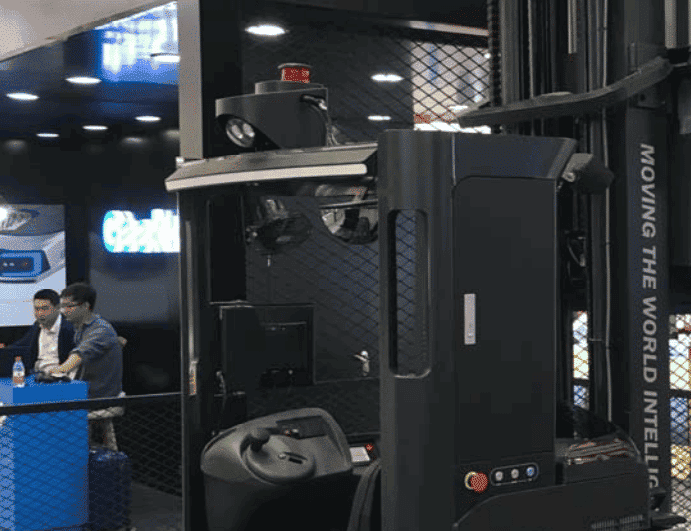
Spot the laser scanner: you might see a laser scanners in green (from Pepperl+Fuchs), blue (from Kollmorgen) or light blue (from SICK).
Laser triangulation is very accurate, but time consuming and expensive to install – which is definitely a consideration when adding automation to your facility. You can read more about the advantages and disadvantages of laser triangulation (and other navigation systems) in our free ebook.
3. No clues? Assume natural navigation
If you can’t spot any clues on the floor, or laser scanners and reflectors up high, you can assume what you’re looking at is probably natural feature navigation.
This means the vehicles are being localized by, and navigating with, data from their built-in safety laser scanners.
ANT natural feature navigation in action at MODEX: no lines on the floor or reflectors on the walls, just smooth movements and precise pickups.
4. Understand why (the type of) natural navigation matters
So you’ve studied the clues and decided what you’re seeing is natural navigation. But what sort of natural navigation – and why does it matter?
There are two main types of natural navigation systems: scan matching and feature matching. While these technologies are similar, there are some key differences which may affect how you decide to invest.
What’s the difference between scan and feature matching? We explain it in the above video, and in this blog post.
For example, vehicles using scan matching natural navigation likely need an extra laser scanner on the top of the vehicle. Feature matching vehicles usually just use the vehicle’s existing safety laser scanners. An additional LiDAR sensor can cost a couple of thousand dollars – an expense which can be avoided with feature matching technology.
As well as the expense, the additional sensor can limit the sort of vehicles you can develop. For example, small ‘mouse’ or ‘turtle’-style AGVs which are designed to move under objects obviously can’t have a sensor mounted on top.
If an extra scanner on the top of the vehicle is such a problem, why do automation suppliers offer it? If the natural navigation approach you choose is scan matching, then the vehicle needs to “see” and recognize a large proportion of features in the environment in order to localize and then navigate. This is much easier to do when the laser is positioned higher up, as less changes.
In comparison, natural navigation with feature matching means that vehicles only need to recognize a small percentage of the environment. This is because features (such as a wall with a unique angle and length) are much easier to recognize than any one point (such as a centimeter-sized patch of that same wall).
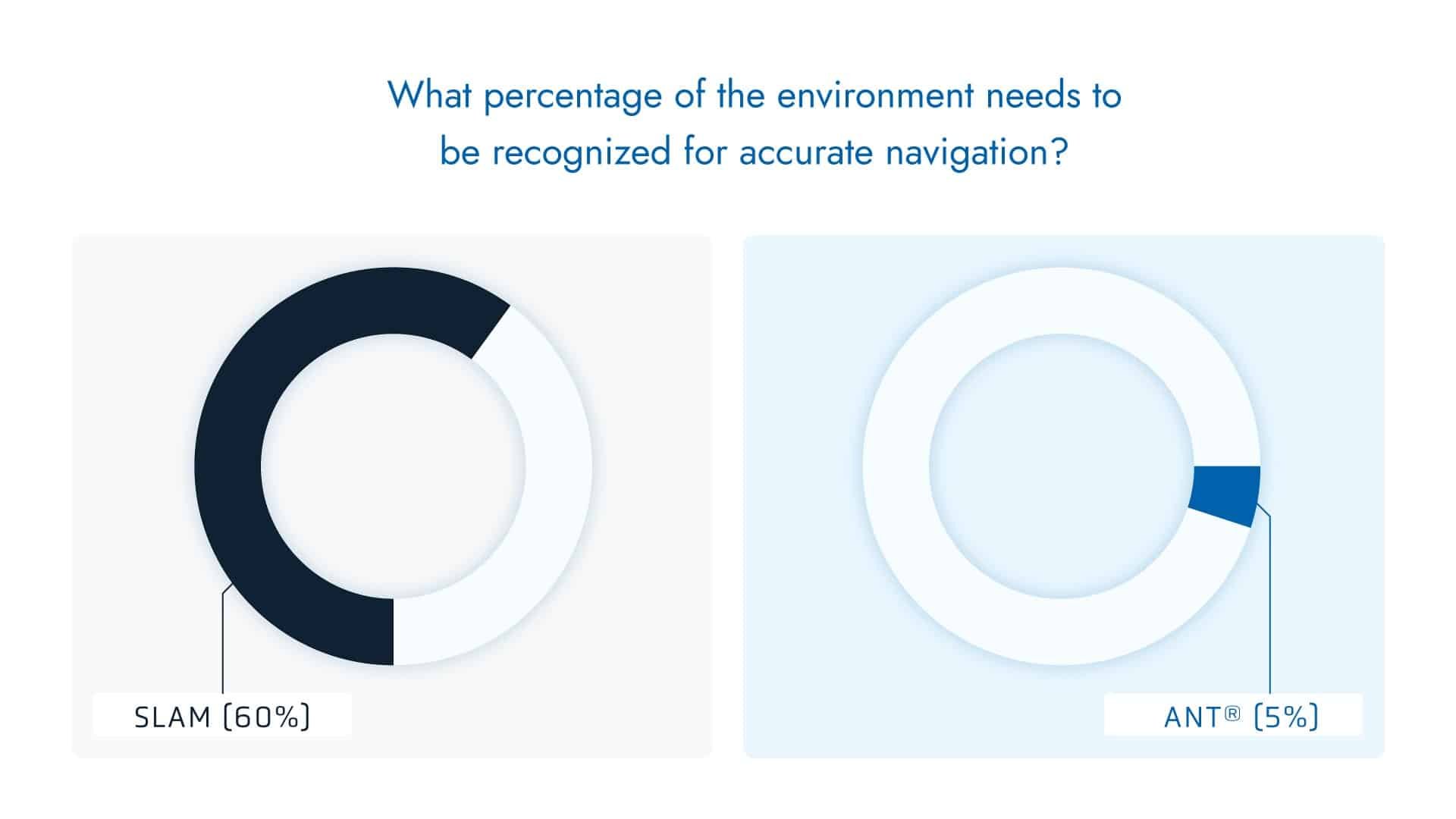
Vehicles using natural navigation with scan matching need to recognize at least 60% of the environment in order to localize and navigate accurately. Vehicles using feature matching such as ANT need to recognize just 5% of the environment for accurate localization and navigation.
Because vehicles using feature matching can navigate accurately when recognizing a relatively small part of the environment, there’s no need for additional laser scanners.
5. Judge how a vehicle actually works
Now that you’ve figured out what technology the vehicles are using, you need to confirm that the technology is mature.
Take a closer look at the booth. How complex is the environment? How fast are the vehicles moving? Are you seeing a single vehicle or a fleet at work?
Is the demo area open or closed? If a demo is taking place in a closed area surrounded by walls, that indicates a perfectly optimized setup which does not reflect the reality of complex work sites.
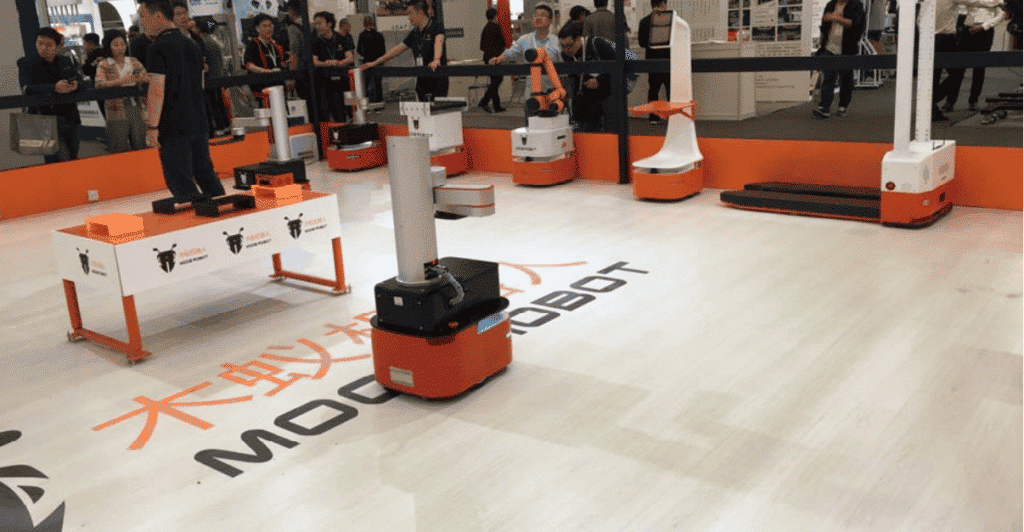
A closed demo area doesn’t help you to assess the performance of a navigation system in the real world.
In our experience, some event organizers require walls for logistics or (perceived) safety. In this case, ask if you can enter the demo area. You should be able to walk through the booth and look how your behavior affects that of the AGVs or AMRs. If that’s impossible – that’s a huge red flag.
6. Enjoy some screen time
Flashy videos are part of the trade show experience – and they can offer useful information. Choosing a navigation supplier is a long-term commitment, and you want to partner with a company that has genuinely deep industry experience. So look for proof – references, case studies and videos of real vehicles. Be wary of animations that show how a vehicle or navigation systems should work – instead concentrate on examples where it does.
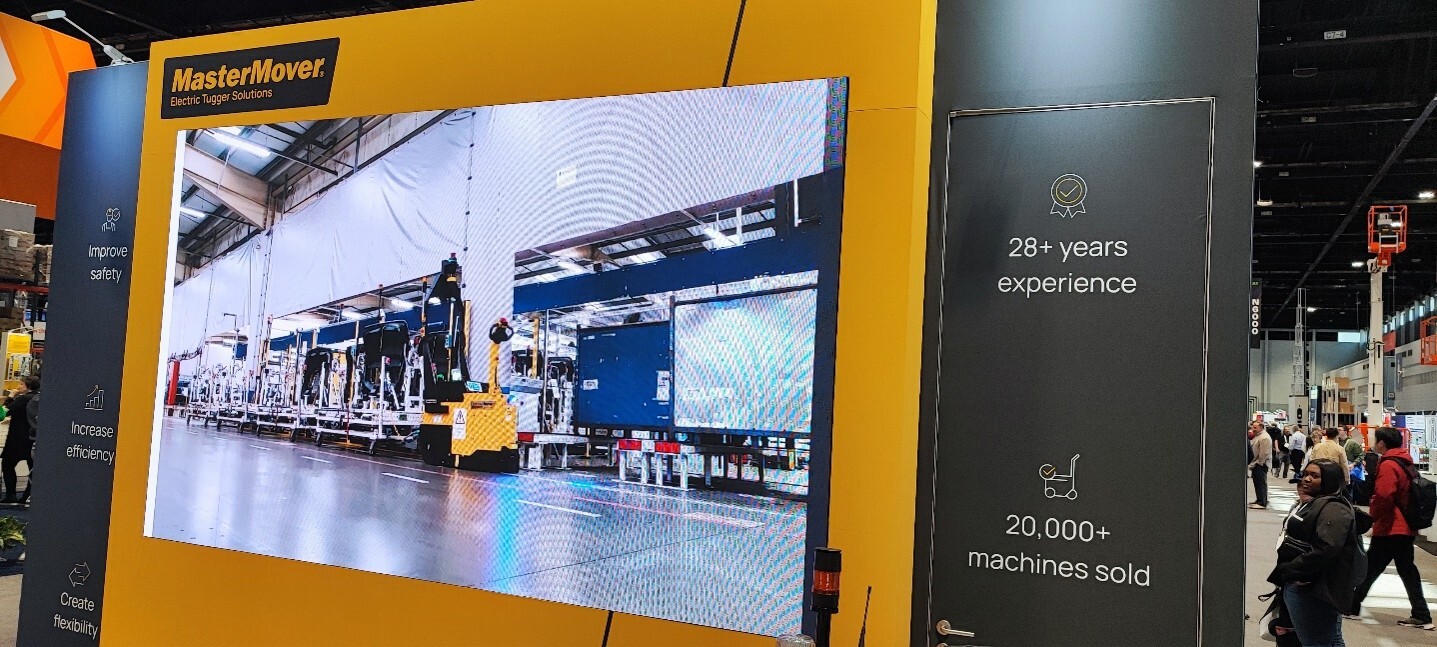 Ignore sexy animations and look for evidence of real customer projects, like this MasterMover installation at
Toyota Motors in the UK.
7. Talk to the people on the booth
Finally – say hello to the people on the booth. They’re there to answer any questions you might have, and are best placed to give you more information.
If you’re considering one of the AGV control systems on display, try asking the supplier a few of these 17 crucial questions.
.jpg?width=1437&height=647&name=BlueBotics%20team%20ProMAT%20(1).jpg) These people are a mine of information. You just have to ask them the right questions!
These people are a mine of information. You just have to ask them the right questions!
Meet BlueBotics at the show
We exhibit at the largest events in each region: MODEX/ProMat in North America, LogiMAT in Europe, CeMAT Asia in China and more.
To see exactly where we will be next, check out our BlueBotics Events Guide. We hope to see you there!
Let's get started
Take the first step to automating your vehicle.
Schedule a call with our expert team today.